Hugh's makeshift stretcher
Happiness for BeginnersHugh's makeshift stretcher is an improvised evacuation litter that enables the BCSC group to carry Hugh from the wilderness after he injures his hip. Built from dismantled pack frames and nylon lash ropes, then padded with a sleeping bag, it is both a piece of emergency equipment and the center of a demanding group effort: the injured man must be kept secure as the bearers negotiate mud, a swollen river, and several miles of trail before reaching an ambulance.
Construction and Design
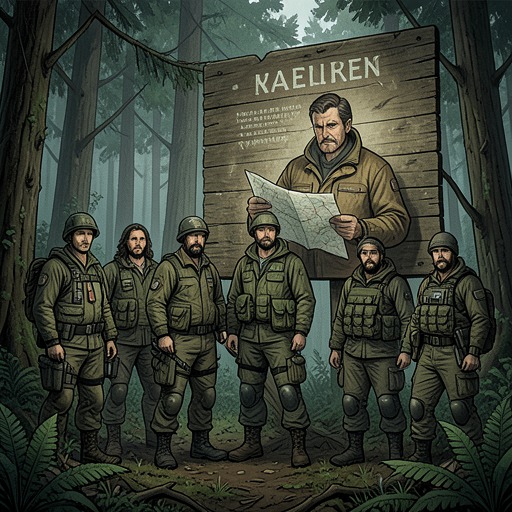
With an evacuation underway, Beckett empties three packs fitted with external aluminum frames and has their owners redistribute their belongings among the remaining packs. He dismantles the frames and weaves several flat nylon ropes, called lashes, around them. Lashed together, the frames form the litter's structure and the woven surface that will support Hugh. Beckett spreads a sleeping bag over that surface for padding, then lies on the finished construction himself to test it. His practical assessment is that it is not comfortable but will serve; the scene presents the litter as a field-built solution rather than specialized equipment.
The stretcher's design draws on materials already carried by the group. Making it requires sacrificing the three framed packs as packs, but redistributing their contents keeps those belongings in circulation while the frames acquire a more urgent use. The sleeping bag, first placed across the woven support as padding, also becomes essential later for securing and protecting Hugh. The object thus takes shape through repurposing: ordinary expedition gear is rearranged into a single device suited to the immediate emergency.
Evacuation Plan and Preparation
Beckett organizes the group around the litter. Six people, including Jake and Helen, are assigned to carry it; the other half shuttle the backpacks ahead in groups. Their destination is the nearest trailhead, about three miles away, where an ambulance is expected to meet them. The arrangement makes the stretcher part of a larger evacuation system: the bearers move Hugh, while the rest of the party advances the equipment needed for the journey and for the group's continued travel.
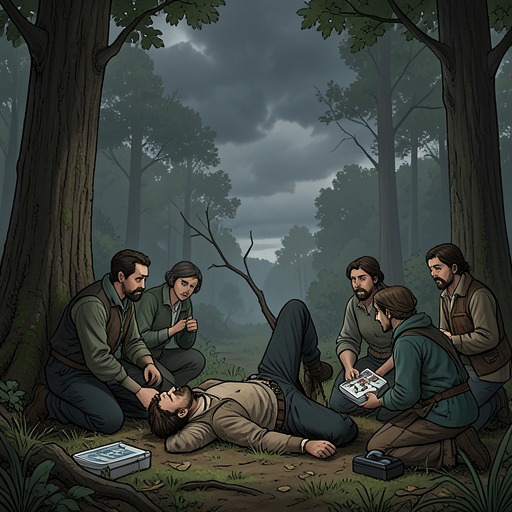
Before lifting, the group has to position Hugh without worsening the ordeal. When he stalls in terror, Helen steps between Jake and Mason and takes his hand, giving Jake the moment needed to call the lift. Hugh screams in agony and passes out again. The group zips him into the sleeping bag for warmth and protection, then lashes him tightly to the litter so he cannot slide around. The padding therefore becomes part of a restraint system as well as a cushion, keeping Hugh in place during movement over uneven ground.
Beckett has the bearers hold the litter at hip height, arms extended down, rather than raising it to their shoulders. He explains that this is easier for them and safer for Hugh in case they drop him. The instruction makes the construction's limits part of the carrying method: the stretcher must be handled in a way that accounts both for the strain on the people bearing it and for the possibility of a fall. Jake, an EMT, is among the assigned bearers, while Beckett directs the operation.
The Journey to the Trailhead
The litter's real test comes on the route out. A slick trail left by a summer shower slows the group; each step slides partly downhill through mud. After lunch, the bearers reach a river swollen by daytime snowmelt. The water rises to mid-thigh on the men and to hip height on Helen, and the cold current pushes at their legs as they carry Hugh's litter high enough to keep it clear of the water. Crossing takes twenty minutes. Helen's legs turn bright red from the cold, and both shoulders cramp so severely that they feel as though they are burning.
The group does not reach the trailhead until three in the afternoon. For a time, Jake's cadence suggests they might arrive earlier, but the muddy section and river crossing extend the evacuation. On the far bank, Hugh is awake when they set him down, while Helen bends over and shakes her arms to loosen her strained shoulders without success. The litter has carried him through the hardest terrain, but doing so has exacted a physical cost from the people supporting it.
Transfer and Aftermath
At the trailhead, neither the BCSC administrator nor the ambulance has arrived. Beckett divides the party again: some stay with Hugh, while the rest go ahead to set up camp and make dinner. Jake stays as the group's EMT, and Helen stays because Hugh is especially comfortable with her. Jake and Beckett leave Hugh strapped into the litter while they wait. The plan is to dismantle it once the ambulance arrives, carry the frames and daypacks onward, and meet the others at a campsite half a mile back from the trailhead.
When the paramedics arrive, transferring Hugh from the homemade litter to the truck takes a long time. The professionals have to redo the group's work properly, and Helen remains beside Hugh even though they will not let her touch him. Once he is secured on their gurney, she moves close enough to kiss him and urge him to be brave; Hugh answers and glances toward Jake as well. The makeshift stretcher has brought Hugh to the point where professional care can take over, but it is not itself the medical gurney: its purpose ends at the handoff. Its significance lies in that practical passage from wilderness to evacuation, and in the coordinated labor that makes the passage possible.